Ring of Fire road to bring prosperity to First Nation, problems for caribou: report

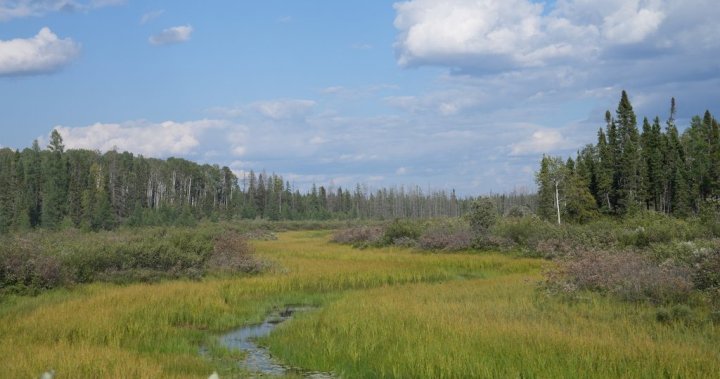
A proposed road to the mineral-rich Ring of Fire in northern Ontario will bring economic prosperity to Webequie First Nation, though it may endanger caribou in the region, a newly released assessment finds.

Webequie First Nation is leading an environmental and impact assessment of the Webequie Supply Road that would connect to mining exploration activities in the Ring of Fire.
That road will connect to two other proposed roads that would link the remote First Nation to the provincial highway system hundreds of kilometres south.
“This is a critical milestone for our people and our project,” Chief Cornelius Wabasse said in a statement.
“We are proud of this important work and the respectful approach taken to get it done. We are also grateful for all those who support Webequie’s journey to self-determination, economic self-reliance and a better future for our people.”
The work and subsequent draft report were done under the province’s Environmental Assessment Act and the federal Impact Assessment Act. The report is thousands of pages long and has been shared with 22 other First Nations in northern Ontario for a 60-day review period, which will be followed by a final report filed to both levels of government.
The assessment examined how the natural and socioeconomic environments, Indigenous land use and traditional knowledge of the area would be affected by building the supply road.
The 107-kilometre, two-lane road will take four to six years to complete once construction begins and will need six bridges and 25 culverts to cross various bodies of water, the report said.
The proposed road will run northwest-southeast for 51 kilometres from the First Nation’s airport to the next segment that will run 56 kilometres east-west to McFaulds Lake and the Eagle’s Nest mineral exploration site.
The proposed mine is owned by Wyloo, an Australian mining company with its Canadian operations based in Toronto.
The road is expected to last 75 years, after which major refurbishments will be needed.

Get daily National news
Get the day’s top news, political, economic, and current affairs headlines, delivered to your inbox once a day.
The projected construction costs to the province are $663 million, though it’s unclear yet who will own the road and who will be allowed to use it. The First Nation said those details will come in future negotiations with Ontario.
“Our vision for the Webequie Supply Road is an economic development road that creates real opportunities for our young people and future generations to drive to work and back,” Wabasse said.
“This project offers possibilities to provide skills training for our youth, create new jobs and business opportunities, and strengthen Webequie’s economic future while remaining deeply connected to our land and traditions.”
The report assumes construction would start in the winter of 2028 and be complete by the summer of 2032, though a start date has yet to be announced.
The report comes amid great debate about mining in northern Ontario.
Premier Doug Ford’s government recently passed Bill 5 into law with the aim to speed up development of mining and other projects. The new legislation has been met with outrage and resistance from First Nations.
The government has given itself the power to suspend provincial and municipal laws through the creation of so-called “special economic zones” for projects it chooses.
The province intends to designate the Ring of Fire the first such zone, though it has said it will not do so until it consults with First Nations in the region. Details about how that would actually work are sparse.
The Webequie Supply Road is expected to have a significantly positive effect on the First Nation’s economy during construction and beyond, the assessment found.
“Community members have emphasized the issues of unemployment and the lack of growth and learning opportunities,” the report said.
“With the anticipated road access connectivity from the project, potential economic growth is expected, leading to job opportunities for community members, allowing them to work closer to home.”
The province has pledged some $70 million to help train Indigenous workers for jobs in development and mining. Wyloo also trains its workers who are conducting mineral exploration at the Eagle’s Nest site.
Other mining and forestry opportunities are likely to arise once the road is built, the report found.
By and large, the threats to animals and plants from road construction are not considered significant, except for a few species at risk that include the boreal caribou.
There are about 5,000 caribou left in the province, the vast majority of them in northern Ontario. Webequie First Nation and the proposed road are within that animal’s range.
The species is considered threatened in Ontario, which means it could become endangered if protective steps are not taken.
Construction and operation of the road is “expected to provide predators such as wolves increased access to the caribou, particularly where the road traverses natural movement corridors,” the report said.
“Overall, caribou injury or death due to changes to predator-prey dynamics from the project is considered a significant adverse effect based on current vulnerability of the population,” the report found.
The construction of the road will also change the caribou’s habitat, it said.
Road construction will also affect another threatened species, wolverines, the report found. There are only two known mature female wolverines in the entire study area. One den is within 400 metres of the proposed road site and “will likely lose function as denning habitat due to the indirect effects of clearing activities.”
About half of the proposed road is in the James Bay Lowlands, which is dominated by peatlands, a weak material to build a road upon. Engineers have decided a “floating road” is the best option, done by “carefully loading materials over peat, allowing time for it to consolidate and increase in strength.”
While building the road will have an effect on all parts of the environment, much of that will be negligible with proper mitigation efforts, the report found.
For example, the report said fish and their habitat will not be significantly affected as crews build the six bridges and 25 culverts because construction barriers will be temporary.
The First Nation is also concerned the road will bring more alcohol and illicit drugs to the community, and said it will try to limit access to outsiders during construction as much as possible.
“Webequie First Nation remains committed to an Indigenous-led approach that supports responsible development while upholding our environmental stewardship responsibilities,” its chief said.


The Ford government is delaying its own affordable housing measures in several major Ontario cities, calling the rules it wrote “unnecessary red tape and requirements” that make it more expensive to build.
The pause will affect inclusionary zoning rules in Toronto, Kitchener and Mississauga, a policy that requires developers to provide a minimum number of affordable housing units in certain situations.
Legislation introduced by the government in May 2025 said municipalities could mandate new projects near transit stations to include five per cent affordable units for a maximum of 25 years after their construction.
It was a provincial compromise that Toronto Mayor Olivia Chow said came nowhere near what she had hoped she could ask for from developers, but which she grudgingly accepted in a meeting with Premier Doug Ford.
“I went in and said, ‘Give us 20 per cent.’ In fact, I appealed for 30 per cent. I said to the premier, ‘We need to build housing — not all of it, but 20, 30 per cent people can afford. It’s a perfect opportunity,’” Chow said at a news conference on Tuesday.
“He said no and now it’s five per cent. I had no choice, I said, ‘OK, five per cent, all right. At least it’s five per cent.’”
Now, the government is pausing its own plan, saying requiring developers to build even five per cent of their units at affordable rates will hurt the construction of new homes.
“We need to get more shovels in the ground to build homes for families across the province — now is not the time to be adding unnecessary red tape and requirements that only increase the cost of building a home,” a spokesperson for Housing Minister Rob Flack, who introduced the legislation less than a year ago, said.
Get breaking National news
For news impacting Canada and around the world, sign up for breaking news alerts delivered directly to you when they happen.
“These temporary measures will help to ensure project viability so more people can call the city of Toronto home.”

The regulation posted by the provincial government proposes pausing the five per cent inclusionary zoning until July 1, 2027. It said Kitchener had already opted to pause its program.
“MMAH has heard from stakeholders expressing concerns that implementing IZ at this juncture, particularly in Toronto, could have a negative impact on overall housing supply and could result in the cancellation or pause of projects,” the regulation said.
Chow, however, said she didn’t believe the requirement was slowing development in her city. She said most builders had stopped working in current conditions, and the few that were still in construction were doing so because of financial incentives from city hall.
“People need homes they can afford,” she said. “Right here, in Toronto, seven out of 10 homes that are being built, if you see a crane, most likely it’s made possible, the building is made possible, because the city has put in financial incentives.”
The Building Industry and Land Development Association said in a statement that the delay was a “prudent” move.


“This will safeguard the already very fragile pipeline of new housing in the province as the market grapples with the lowest sales seen in decades, declining starts and mounting layoffs in the GTA,” the statement said.
“Present cost-to-build challenges, new home sales, and market conditions are extremely dire in the province and adding even more costs through IZ requirements would simply further erode project viabilities and result in even fewer housing units coming to the market.”
The Ford government ran its 2022 election campaign partly under the promise that it would build 1.5 million new homes by 2031 to lower the cost of housing in the province. It’s a strategy that has stalled to the point that the finance minister recently called the 1.5 million goal a “soft target,” after years of failing to hit key milestones, even after watering down the criteria.
Flack told Global News last year that recent provincial housing measures were designed to revive the spring market for 2026, after consecutive years where the number of housing starts in Ontario fell — often at sharper rates than the rest of the country.
The fall-off in development has perhaps been most acute in Toronto.
Between 2020 and 2025, 25 projects have stopped sales on more than 3,200 new units in and around Toronto, numbers compiled by BILD show.
A total of six projects stopped selling in 2020, with five more giving up the following year. In 2022, 10 projects abandoned sales attempts, while four more folded in 2023.
BILD said no projects had stopped selling in 2024 or 2025 because fewer than 10 highrises have even tried to launch over the last two years, as builders struggle to make the costs work and buyers stay away.
The low sales matter to builders because most condominium projects require the majority of their units to be sold in order to finalize financing to get construction off the ground.
Richard Lyall, president of RESCON, said recent data shows “we are staring into the abyss” when it comes to residential construction.
— with a file from The Canadian Press
© 2026 Global News, a division of Corus Entertainment Inc.

Gaye and Jim O’Neill have spent countless hours thinking about their daughter’s final hours in April 2023.
It’s a memory they say they’d wish on no one — and it’s the reason why they joined a years-long legal campaign to change the way medical assistance in dying is delivered in British Columbia.
The O’Neills are at the centre of a Charter of Rights challenge, now before the B.C. Supreme Court, that seeks to end the practice of so-called “forced transfers” — compelling patients to leave faith-based medical facilities before receiving medical assistance in dying.
Sam O’Neill died with medical assistance at age 34, roughly a year after she was diagnosed with cervical cancer that had spread to other parts of her body.
Her family remembers Sam, the eldest of three children, as stubborn and fiercely independent, kind and encouraging. She loved animals — so much so that she tried to convince loved ones to take up her vegan lifestyle.
“She would stick up for the rights of animals, but she also stuck up for the rights for people. She never wanted a bad word about people,” said Gaye O’Neill.
Sam travelled the world before moving from her home province of Ontario to Vancouver, where she built a rich life with a close-knit circle of friends. She wrote a travel blog, which Gaye said was “hysterically funny.”
Sam was active: she played soccer and hockey as a kid, and her kind nature and big heart endeared her to teammates. She logged a personal best time in her 10th marathon in California in December 2021.
So it was a shock to her parents when, just four months later in April 2022, they learned she was sick.
Gaye and Jim flew to Vancouver on May 1 to see her.

“She was supposed to be running (a marathon) that day, but she was in a hospital with cancer. So it was terrible,” Jim said.
She went through chemotherapy and radiation treatments, spending that year in and out of Vancouver’s St. Paul’s Hospital. The hospital is operated by Providence Health Care Society, a Catholic organization that runs 18 health care facilities in the Vancouver area.

Get weekly health news
Receive the latest medical news and health information delivered to you every Sunday.
Sam was assessed for medical assistance in dying, better known as MAID, early in 2023 — something she didn’t tell her family about in advance.
“I was talking to her over the phone. She said she qualified for MAID and I thought she was getting someone to clean her house,” Jim said.
Sam wanted the option of MAID in the event that things got worse, he said.
Things got worse in March 2023. Sam hurt herself while unpacking from a move, her parents said, and she was taken back to St. Paul’s by ambulance.
Over the next several weeks, the staff tried to help her manage the pain.
“I remember one palliative care doctor saying, ‘She’s on as high a dosage that’s safe. We can’t give her more pain meds,’” Jim said.
After two painful procedures in early April, Sam decided to obtain a medically assisted death. She needed first to move from the hospital where she was receiving treatment — because Providence does not allow assisted dying in its facilities. The province of B.C. allows faith-based organizations to be exempt from its MAID policies.
Court documents filed by Providence state that Sam was aware that she wouldn’t be allowed to end her life at St. Paul’s.
Sam was transferred to St. John Hospice. The hospice itself is also run by Providence, but there is an adjacent space in the same building, which is operated by Vancouver Coastal Health, where MAID is permitted.
Her parents said her final hours were spent in agony and her ability to say goodbye to loved ones was impeded by the need to sort out logistics for her transfer.


Her parents said that when they went to see her one final time before the move, they were distressed to find her sitting on a commode and wrapped in a sheet.
“It was shocking and terrible … it was just so humiliating for her,” Gaye said.
Sam was heavily sedated for the transfer and did not wake up again.

Providence defended the care Sam received in court filings, stating that her family and friends were able to “say goodbye to her privately in her room throughout the day.” The organization also said she chose to be sedated before the move.
Its statement of defence also says that Sam’s condition affected her gastrointestinal function and she was “on a commode for her comfort and at her request.”
Daphne Gilbert, a law professor at the University of Ottawa, said she heard about the O’Neill family’s story through the media and contacted them to see if they’d be interested in taking the case to court.
“I had been looking for and thinking about ways to litigate the issue of forced transfers, and I knew that we needed a plaintiff who would be willing to be part of the lawsuit,” she said.
Alongside advocacy group Dying With Dignity Canada and Dr. Jyothi Jayaraman — a palliative care physician who left her job with Providence Health because she disagreed with the practice of transferring MAID patients — the O’Neills are now arguing their case before the B.C. Supreme Court.
The court will be asked to decide whether institutions like Providence have the same rights to protection of freedom of religion as individuals. Providence will argue that it does and that being required to deliver MAID would infringe upon its rights.
The Charter challenge likely will end up being appealed to the Supreme Court of Canada, Gilbert said.
That means Gaye and Jim O’Neill have a fight ahead of them that could last years.
“We cannot do anything at all to help Sam. There’s nothing we can do. What’s done is done,” Gaye said.
“We want to protect other people,” Jim added.

Air Canada says it is investigating an incident last month where a ground crew member was trapped inside the cargo hold of a flight departing Toronto, after video of the event surfaced on social media earlier this month.
The incident occurred on Air Canada Flight AC1502, scheduled to travel from Toronto Pearson Airport to Moncton, N.B., on Dec. 13, 2025.
In a video posted Jan. 3, 2026, by a passenger using the handle @travel.with.stephy, a voice can be heard on the intercom addressing passengers following the aircraft’s return to the gate.
“I’ve never had that in my life… first time, hopefully the last,” the voice said. “That’s the reason we had to go back to the gate and get that person out of the airplane. The good news is that the person is perfectly fine and safe.”
He said paperwork needed to be completed before departure and apologized for the delay, assuring passengers the flight would proceed to Moncton as soon as possible.
Get daily National news
Get the day’s top news, political, economic, and current affairs headlines, delivered to your inbox once a day.
According to the passenger, the aircraft had already begun taxiing when a baggage crew member could be heard yelling for help and banging from underneath the aircraft.
The passenger later wrote that the flight ultimately did not reach Moncton that day and that travellers were informed the delay was considered outside the airline’s control.


In a statement to Global News, Air Canada confirmed the incident, saying the aircraft’s cargo doors were inadvertently closed while a member of the ground crew was inside.
“Upon discovery, the aircraft returned to the gate and the doors were opened,” the airline said. “There were no injuries.”
The video prompted widespread reaction online, with commenters expressing concern over ground-handling safety procedures and questioning how such an incident could occur.
One commenter who claimed to work as ground crew wrote under the post, “I used to be a baggage guy, this is scary.”
The incident is currently under investigation.
© 2026 Global News, a division of Corus Entertainment Inc.
-

 Uncategorized7 months ago
Shop Proud, Eat Proud, Be Proud — Ottawa Canada Day Market This June 28th
-
 7 months ago
Ontario First Nation residents take shelter in Toronto-area amid wildfires
-

 7 months ago
161 bricks of suspected cocaine found on truck trying to cross Canada-U.S. border
-

 7 months ago
Measles circulating in northeastern B.C. community, health officials warn
-

 7 months ago
Canada’s world junior trial saw juries tossed, intense testimony. Here’s a recap
-

 7 months ago
Former major leaguer, Jays doctor Ron Taylor dies
-

 7 months ago
Jagmeet Singh apologizes for attending Kendrick Lamar concert after Drake calls him out
-

 7 months ago
Anishinabek Nation chief says he briefed Ontario police on protests against Bill 5