Air Canada investigating after ground crew member trapped in cargo hold


Air Canada says it is investigating an incident last month where a ground crew member was trapped inside the cargo hold of a flight departing Toronto, after video of the event surfaced on social media earlier this month.

The incident occurred on Air Canada Flight AC1502, scheduled to travel from Toronto Pearson Airport to Moncton, N.B., on Dec. 13, 2025.
In a video posted Jan. 3, 2026, by a passenger using the handle @travel.with.stephy, a voice can be heard on the intercom addressing passengers following the aircraft’s return to the gate.
“I’ve never had that in my life… first time, hopefully the last,” the voice said. “That’s the reason we had to go back to the gate and get that person out of the airplane. The good news is that the person is perfectly fine and safe.”
He said paperwork needed to be completed before departure and apologized for the delay, assuring passengers the flight would proceed to Moncton as soon as possible.

Get daily National news
Get the day’s top news, political, economic, and current affairs headlines, delivered to your inbox once a day.
According to the passenger, the aircraft had already begun taxiing when a baggage crew member could be heard yelling for help and banging from underneath the aircraft.
The passenger later wrote that the flight ultimately did not reach Moncton that day and that travellers were informed the delay was considered outside the airline’s control.


In a statement to Global News, Air Canada confirmed the incident, saying the aircraft’s cargo doors were inadvertently closed while a member of the ground crew was inside.
“Upon discovery, the aircraft returned to the gate and the doors were opened,” the airline said. “There were no injuries.”
The video prompted widespread reaction online, with commenters expressing concern over ground-handling safety procedures and questioning how such an incident could occur.
One commenter who claimed to work as ground crew wrote under the post, “I used to be a baggage guy, this is scary.”
The incident is currently under investigation.
© 2026 Global News, a division of Corus Entertainment Inc.


The Ford government is delaying its own affordable housing measures in several major Ontario cities, calling the rules it wrote “unnecessary red tape and requirements” that make it more expensive to build.
The pause will affect inclusionary zoning rules in Toronto, Kitchener and Mississauga, a policy that requires developers to provide a minimum number of affordable housing units in certain situations.
Legislation introduced by the government in May 2025 said municipalities could mandate new projects near transit stations to include five per cent affordable units for a maximum of 25 years after their construction.
It was a provincial compromise that Toronto Mayor Olivia Chow said came nowhere near what she had hoped she could ask for from developers, but which she grudgingly accepted in a meeting with Premier Doug Ford.
“I went in and said, ‘Give us 20 per cent.’ In fact, I appealed for 30 per cent. I said to the premier, ‘We need to build housing — not all of it, but 20, 30 per cent people can afford. It’s a perfect opportunity,’” Chow said at a news conference on Tuesday.
“He said no and now it’s five per cent. I had no choice, I said, ‘OK, five per cent, all right. At least it’s five per cent.’”
Now, the government is pausing its own plan, saying requiring developers to build even five per cent of their units at affordable rates will hurt the construction of new homes.
“We need to get more shovels in the ground to build homes for families across the province — now is not the time to be adding unnecessary red tape and requirements that only increase the cost of building a home,” a spokesperson for Housing Minister Rob Flack, who introduced the legislation less than a year ago, said.
Get breaking National news
For news impacting Canada and around the world, sign up for breaking news alerts delivered directly to you when they happen.
“These temporary measures will help to ensure project viability so more people can call the city of Toronto home.”

The regulation posted by the provincial government proposes pausing the five per cent inclusionary zoning until July 1, 2027. It said Kitchener had already opted to pause its program.
“MMAH has heard from stakeholders expressing concerns that implementing IZ at this juncture, particularly in Toronto, could have a negative impact on overall housing supply and could result in the cancellation or pause of projects,” the regulation said.
Chow, however, said she didn’t believe the requirement was slowing development in her city. She said most builders had stopped working in current conditions, and the few that were still in construction were doing so because of financial incentives from city hall.
“People need homes they can afford,” she said. “Right here, in Toronto, seven out of 10 homes that are being built, if you see a crane, most likely it’s made possible, the building is made possible, because the city has put in financial incentives.”
The Building Industry and Land Development Association said in a statement that the delay was a “prudent” move.


“This will safeguard the already very fragile pipeline of new housing in the province as the market grapples with the lowest sales seen in decades, declining starts and mounting layoffs in the GTA,” the statement said.
“Present cost-to-build challenges, new home sales, and market conditions are extremely dire in the province and adding even more costs through IZ requirements would simply further erode project viabilities and result in even fewer housing units coming to the market.”
The Ford government ran its 2022 election campaign partly under the promise that it would build 1.5 million new homes by 2031 to lower the cost of housing in the province. It’s a strategy that has stalled to the point that the finance minister recently called the 1.5 million goal a “soft target,” after years of failing to hit key milestones, even after watering down the criteria.
Flack told Global News last year that recent provincial housing measures were designed to revive the spring market for 2026, after consecutive years where the number of housing starts in Ontario fell — often at sharper rates than the rest of the country.
The fall-off in development has perhaps been most acute in Toronto.
Between 2020 and 2025, 25 projects have stopped sales on more than 3,200 new units in and around Toronto, numbers compiled by BILD show.
A total of six projects stopped selling in 2020, with five more giving up the following year. In 2022, 10 projects abandoned sales attempts, while four more folded in 2023.
BILD said no projects had stopped selling in 2024 or 2025 because fewer than 10 highrises have even tried to launch over the last two years, as builders struggle to make the costs work and buyers stay away.
The low sales matter to builders because most condominium projects require the majority of their units to be sold in order to finalize financing to get construction off the ground.
Richard Lyall, president of RESCON, said recent data shows “we are staring into the abyss” when it comes to residential construction.
— with a file from The Canadian Press
© 2026 Global News, a division of Corus Entertainment Inc.

Gaye and Jim O’Neill have spent countless hours thinking about their daughter’s final hours in April 2023.
It’s a memory they say they’d wish on no one — and it’s the reason why they joined a years-long legal campaign to change the way medical assistance in dying is delivered in British Columbia.
The O’Neills are at the centre of a Charter of Rights challenge, now before the B.C. Supreme Court, that seeks to end the practice of so-called “forced transfers” — compelling patients to leave faith-based medical facilities before receiving medical assistance in dying.
Sam O’Neill died with medical assistance at age 34, roughly a year after she was diagnosed with cervical cancer that had spread to other parts of her body.
Her family remembers Sam, the eldest of three children, as stubborn and fiercely independent, kind and encouraging. She loved animals — so much so that she tried to convince loved ones to take up her vegan lifestyle.
“She would stick up for the rights of animals, but she also stuck up for the rights for people. She never wanted a bad word about people,” said Gaye O’Neill.
Sam travelled the world before moving from her home province of Ontario to Vancouver, where she built a rich life with a close-knit circle of friends. She wrote a travel blog, which Gaye said was “hysterically funny.”
Sam was active: she played soccer and hockey as a kid, and her kind nature and big heart endeared her to teammates. She logged a personal best time in her 10th marathon in California in December 2021.
So it was a shock to her parents when, just four months later in April 2022, they learned she was sick.
Gaye and Jim flew to Vancouver on May 1 to see her.

“She was supposed to be running (a marathon) that day, but she was in a hospital with cancer. So it was terrible,” Jim said.
She went through chemotherapy and radiation treatments, spending that year in and out of Vancouver’s St. Paul’s Hospital. The hospital is operated by Providence Health Care Society, a Catholic organization that runs 18 health care facilities in the Vancouver area.

Get weekly health news
Receive the latest medical news and health information delivered to you every Sunday.
Sam was assessed for medical assistance in dying, better known as MAID, early in 2023 — something she didn’t tell her family about in advance.
“I was talking to her over the phone. She said she qualified for MAID and I thought she was getting someone to clean her house,” Jim said.
Sam wanted the option of MAID in the event that things got worse, he said.
Things got worse in March 2023. Sam hurt herself while unpacking from a move, her parents said, and she was taken back to St. Paul’s by ambulance.
Over the next several weeks, the staff tried to help her manage the pain.
“I remember one palliative care doctor saying, ‘She’s on as high a dosage that’s safe. We can’t give her more pain meds,’” Jim said.
After two painful procedures in early April, Sam decided to obtain a medically assisted death. She needed first to move from the hospital where she was receiving treatment — because Providence does not allow assisted dying in its facilities. The province of B.C. allows faith-based organizations to be exempt from its MAID policies.
Court documents filed by Providence state that Sam was aware that she wouldn’t be allowed to end her life at St. Paul’s.
Sam was transferred to St. John Hospice. The hospice itself is also run by Providence, but there is an adjacent space in the same building, which is operated by Vancouver Coastal Health, where MAID is permitted.
Her parents said her final hours were spent in agony and her ability to say goodbye to loved ones was impeded by the need to sort out logistics for her transfer.


Her parents said that when they went to see her one final time before the move, they were distressed to find her sitting on a commode and wrapped in a sheet.
“It was shocking and terrible … it was just so humiliating for her,” Gaye said.
Sam was heavily sedated for the transfer and did not wake up again.

Providence defended the care Sam received in court filings, stating that her family and friends were able to “say goodbye to her privately in her room throughout the day.” The organization also said she chose to be sedated before the move.
Its statement of defence also says that Sam’s condition affected her gastrointestinal function and she was “on a commode for her comfort and at her request.”
Daphne Gilbert, a law professor at the University of Ottawa, said she heard about the O’Neill family’s story through the media and contacted them to see if they’d be interested in taking the case to court.
“I had been looking for and thinking about ways to litigate the issue of forced transfers, and I knew that we needed a plaintiff who would be willing to be part of the lawsuit,” she said.
Alongside advocacy group Dying With Dignity Canada and Dr. Jyothi Jayaraman — a palliative care physician who left her job with Providence Health because she disagreed with the practice of transferring MAID patients — the O’Neills are now arguing their case before the B.C. Supreme Court.
The court will be asked to decide whether institutions like Providence have the same rights to protection of freedom of religion as individuals. Providence will argue that it does and that being required to deliver MAID would infringe upon its rights.
The Charter challenge likely will end up being appealed to the Supreme Court of Canada, Gilbert said.
That means Gaye and Jim O’Neill have a fight ahead of them that could last years.
“We cannot do anything at all to help Sam. There’s nothing we can do. What’s done is done,” Gaye said.
“We want to protect other people,” Jim added.
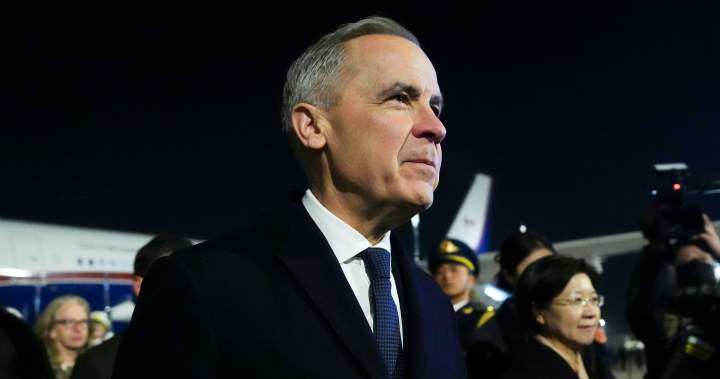
With U.S. President Donald Trump’s tariffs forcing Canada to seek other trading partners, Prime Minister Mark Carney’s visit to China is raising questions about whether some tariffs between Beijing and Ottawa could soon ease in what one expert is calling a “test” for where relations may go.
Canada’s rocky relationship with China has spanned several years, and pre-dates the global trade war sparked by Trump’s tariffs.
But recent diplomatic tension, including the arbitrary detention of two Canadians as well as the executions last year of four Canadians by Beijing, coupled with pressure from the U.S. for allies to crack down on trade with China have spurred rounds of tariffs between Canada and China covering industries like agriculture and electric vehicles.
Carney’s trip comes just days after an Ipsos poll done exclusively for Global News found 54 per cent of Canadians support closer trade ties and economic agreements with China.
“This visit by Carney to China is also a test. It’s very sensitive. It’s to test the Canadian public, also to test the U.S. reaction,” says Howard Lin, a professor emeritus and the founding director of the Canada-China Institute for Business and Development at Toronto Metropolitan University.
Some experts suggest that these meetings are a strategy by Carney to add pressure on Trump to come to the bargaining table and renew or negotiate an alternative to the Canada-United States-Mexico Trade Agreement (CUSMA), which is up for renegotiation this year.
Trump said earlier this week “it wouldn’t matter to me” if the current trade deal were to expire.
Here’s a look at where things stand ahead of Carney’s meetings with Chinese leaders.

Why there are tariffs between Canada and China?
Relations between the two countries have been strained for nearly a decade.
The most recent chapter of strain began in 2018, during Trump’s first term, when the RCMP arrested then-Huawei CFO Meng Wanzhou in Vancouver at the behest of American authorities.
Canada has an extradition agreement with the U.S.
Get daily National news
Get the day’s top news, political, economic, and current affairs headlines, delivered to your inbox once a day.
At the time, Wanzhou was an executive at the China-based global telecommunications technology company and was wanted in the United States on international fraud charges.
About a week later, China arrested two Canadians, who became known as the two Michaels, and would later be held on widely condemned charges of espionage and held for several years in China.
“Since the two Michaels situation, there’s been trouble with trade to China. That was completely unacceptable, a diplomat was kidnapped. And so I’m not really sure what’s changed. The same people are in power, the same economic conditions with China are still around,” says Kevin Bryan, an associate professor of strategic management at the University of Toronto.
“It’s not like we’re trying to increase trade to Sweden. We’re trying to increase trade to China, where we recently had serious economic espionage and serious geopolitical issues with that country.”
Carney has vowed to double non-U.S. exports over the next decade — and China is the world’s second-largest economy.
“For Canada, this is kind of a pragmatic economic engagement, a reset. We have sectors like agriculture, which are really eager to re-enter the Chinese market,” says Lin.
“China’s objective is a little bit different. I think they would consider this visit as a strategic diplomatic win because in this political landscape, China wants to see they’re not totally isolated and considered a responsible partner that can be talked with.”

What tariffs are in place now?
In October 2024, Canada began imposing a 100 per cent tariff on all imported electric and hybrid-electric vehicles produced in China, mirroring measures taken by the U.S. amid concerns about heavy Chinese subsidies and industrial dumping.
Canada also has a 25 per cent tariff on Chinese steel and aluminum over similar concerns.
China retaliated to those moves with duties of their own. Shortly after Canada imposed those tariffs, China began investigating Canadian canola imports on similar claims of dumping.
Dumping in the context of exporting refers to when a business artificially lowers the price of its products to be significantly lower than its own domestic pricing standards.

The theory is by doing this, one nation’s industry can undermine that of another nation’s and make it difficult to compete with those products being imported.
In March 2025, China imposed a 100 per cent tariff on Canadian canola oil, canola meal and peas.
This was in addition to a 25 per cent tariff on Canadian pork and seafood products.
In August 2025, China also added a nearly 76 per cent tariff on canola seed.
China is the world’s largest importer of canola oil and canola products, with nearly all of it coming from Canada. The Canadian canola industry generates more than $43 billion per year and employs about 200,000 workers, which have been given some financial supports from the federal government in the interim.
Carney is being joined by Saskatchewan Premier Scott Moe in China, as canola farmers from the Prairie province say they are hopeful for some relief to their industry.

What could come from Carney’s meetings
Canola tariffs are widely expected to be among the items on the agenda for the meetings.
But experts caution that Carney may have to offer some concessions to get any shifts from China.
Lin says it’s “almost guaranteed that China will reopen the agriculture market.”
“Western Canada is really a strong voice for a normalized relationship with China, and China will use that to argue that concession to be made from the Canadian side and then they’ll say, ‘what can we get?‘
“Maybe we just export more oil, or even clean energy. The Chinese are really focused on electric cars, steel and aluminum, but these things are very sensitive.“
Dropping tariffs on Chinese EVs or steel and aluminum could be politically challenging, given U.S. focus on those industries and the push from the administration for countries to crack down.
The United States, and Trump himself will likely be paying close attention, and Bryan says “there’s a risk” that whatever comes from these meetings may affect the future of CUSMA.
There may still be other ways for Carney to build a bridge with Beijing.
Chinese media also suggested this week that in order to mend ties between Canada and China, Canada will need to represent itself independently from the U.S.
Lin says Carney and his team need to be “cautious” at these meetings given the stakes.
“It’s kind of interesting that President Trump seems to have an American-only kind of attitude recently. He even said the trade agreement between the U.S., Canada and Mexico, ‘I don’t now if that matters’ or something. So, I think he has his own plan,” says Lin.
“I think Carney has to be cautious to say what we’ve got to say, because Canada still has a disagreement on the other front.”
-

 Uncategorized7 months ago
Shop Proud, Eat Proud, Be Proud — Ottawa Canada Day Market This June 28th
-

 7 months ago
Ontario First Nation residents take shelter in Toronto-area amid wildfires
-

 7 months ago
161 bricks of suspected cocaine found on truck trying to cross Canada-U.S. border
-

 7 months ago
Ring of Fire road to bring prosperity to First Nation, problems for caribou: report
-

 7 months ago
Measles circulating in northeastern B.C. community, health officials warn
-

 7 months ago
Canada’s world junior trial saw juries tossed, intense testimony. Here’s a recap
-

 7 months ago
Former major leaguer, Jays doctor Ron Taylor dies
-

 7 months ago
Jagmeet Singh apologizes for attending Kendrick Lamar concert after Drake calls him out